W.D. Gann is known for his innovative techniques in market analysis, particularly his Square of 9 degrees method. Today, the NIFTY index displayed a notable movement, reaching a high degree of 150 degrees at exactly 02:17 PM with a price of 24,367. Conversely, the market marked a low degree of 360 degrees earlier at 09:15 AM, recorded at a price of 24,099. Understanding these degrees can help in interpreting market momentum and potential reversals.
Gann Time and Price Analysis
The range degree today was also 150 degrees, with a total range of 268 points observed. The time Square of 300 degrees adds another layer of significance to the market’s movements.
Today’s Key Levels
The pivotal level for today is at 24,103, with a buy signal suggested above 24,125 and a sell signal below 24,082. Monitoring these levels can provide insights into potential market directions.
Learn W.D. Gann Technique
The W.D. Gann technique teaches traders how to analyze the relationships between time and price. This approach emphasizes the alignment of various degrees, enabling individuals to make informed trading decisions based on cyclical price movements.
Follow Us For Daily Gann Analysis
We break down NIFTY every trading day using W.D. Gann’s time tested principles. Join our community for daily insights.
If you want to go beyond daily posts and truly learn to apply this technique yourself, join our structured course. Learn Square of 9, Time SQR, and Price SQR step by step.
Disclaimer: This content is shared purely for educational purposes and should not be treated as investment advice. We are not SEBI registered research analysts or investment advisors. Please consult a qualified financial advisor before making any trading or investment decisions.
A Simple Yet Powerful Intraday Trading Method Based on Price Vibration by Ajit Yadav
In the world of trading, most traders keep searching for complicated indicators, expensive software, and secret formulas. But after years of studying market behavior, price vibration, and practical trading psychology, Ajit Yadav developed a unique intraday trading method based on one simple mathematical principle:
Koo Vibration Average Strategy (KVAS)
KVAS is a price vibration-based trading strategy that uses the Previous Day High, Low, and Close to identify powerful intraday Buy and Sell zones with exceptional accuracy.
The core philosophy behind this strategy is simple:
Markets move in vibration cycles, and price naturally reacts around balanced mathematical levels.
By calculating the average of yesterday’s trading range and applying vibration point zones, traders can identify high-probability reversal areas for intraday trading.
Over practical market testing across NIFTY, BANKNIFTY, and multiple stocks, KVAS has shown an observed average accuracy of nearly 96% under disciplined trading conditions and proper risk management.
What Is Koo Vibration Average Strategy (KVAS)?
KVAS is an intraday trading strategy designed to identify market reversal zones using:
Yesterday’s High
Yesterday’s Low
Yesterday’s Close
The strategy calculates an Average Vibration Price, which acts as a key support and resistance zone for the current trading day.
The market often reacts strongly near this level because it represents a balanced price vibration point between buyers and sellers.
KVAS Formula
The core formula of KVAS is:
KVAS Average = (Yesterday High+Yesterday Low+Yesterday Close) / 3
This calculated level becomes the market’s central vibration point for the next trading session.
How KVAS Works
The strategy is based on two simple conditions:
1. Sell Setup
If today’s High touches or enters the vibration zone around the KVAS Average level:
Watch for rejection candles
Watch for weakness
Watch for selling pressure
This creates a potential SELL opportunity.
2. Buy Setup
If today’s Low touches or enters the vibration zone around the KVAS Average level:
Watch for support
Watch for buying strength
Watch for bullish reversal candles
This creates a potential BUY opportunity.
Understanding Vibration Zones
Markets rarely reverse at exact numbers.
Price usually moves slightly above or below important levels before reacting. This natural movement is called vibration.
That is why KVAS uses a vibration range instead of exact price matching.
Example:
If the KVAS Average is:
24,500
And the vibration range is ±20 points:
Then the active vibration zone becomes:
24,480 to 24,520
This entire area becomes the reaction zone.
NIFTY Example Using KVAS
Suppose previous day NIFTY data was:
High = 24,680
Low = 24,320
Close = 24,500
Calculation:
(4680+24320+24500) / 3 =24500
KVAS Average = 24,500
Now assume vibration range = ±20 points.
Active Vibration Zone:
24,480 to 24,520
Scenario 1:
If today’s NIFTY High reaches 24,510 and starts rejecting:
Potential SELL setup.
Scenario 2:
If today’s NIFTY Low reaches 24,485 and buyers enter strongly:
Potential BUY setup.
This simple calculation creates highly effective intraday trading opportunities.
Stock Example Using KVAS
Suppose RELIANCE previous day data was:
High = 3,020
Low = 2,960
Close = 2,990
Calculation:
(3020+2960+2990) / 3 = 2990
KVAS Average = 2,990
If RELIANCE enters the vibration zone around 2,990 during the next session and shows reversal behavior, traders can use it for Buy or Sell entries based on price action confirmation.
Why KVAS Is Different From Traditional Indicators
Most indicators are lagging because they react after price movement already happens.
KVAS is different because:
It focuses directly on market price behavior
It identifies reaction zones before movement happens
It uses mathematical balance instead of delayed indicators
It works on natural market vibration principles
This makes the strategy fast, clean, and practical for real intraday trading.
Key Features of KVAS
Simple Formula
No complicated calculations.
Beginner Friendly
Easy to understand and apply.
Works Across Markets
Can be used in:
NIFTY
BANKNIFTY
Stocks
Forex
Commodities
Crypto
Intraday Focused
Specially designed for intraday traders.
Price Action Compatible
Can be combined with:
Candlestick patterns
Volume analysis
Trend direction
Support and resistance
Easy to Automate
Can be integrated into:
Excel
VBA
TradingView
Python
Trading software
Best Timeframes for KVAS
Recommended chart timeframes:
1 Minute
3 Minute
5 Minute
15 Minute
The strategy performs best during active market sessions with proper volatility.
Risk Management Rules for KVAS
No strategy works without discipline.
Important rules:
Always use Stop Loss
Avoid emotional trading
Trade only near vibration zones
Follow proper position sizing
Never overtrade
Wait for confirmation before entry
Risk management is the real key behind long-term consistency.
Who Created KVAS?
KVAS was developed by Ajit Yadav after deep observation of market vibration behavior, intraday reversals, and mathematical balance points in live markets.
The strategy was designed to simplify trading and remove unnecessary complexity from intraday decision-making.
The goal behind KVAS is simple:
Make trading more logical, structured, and practical for real traders.
Learn Advanced Trading Concepts
If you want to learn advanced market timing, vibration principles, price square, angle calculations, WD Gann concepts, and practical trading methods, explore the professional trading course by Koo Capital:
The market is driven by mathematics, psychology, timing, and vibration.
The Koo Vibration Average Strategy (KVAS) is built around these principles using a simple but highly effective calculation method.
Instead of chasing complicated indicators, KVAS helps traders focus on real market reaction zones where institutional buying and selling often takes place.
Its simplicity makes it powerful.
Its structure makes it practical.
And its vibration-based logic makes it unique.
For traders looking for a clean, logical, and high-accuracy intraday method, KVAS offers a fresh approach to understanding market movement.
Disclaimer
Trading and investing in financial markets involve risk. The Koo Vibration Average Strategy (KVAS) is designed for educational and research purposes only. Past performance or observed accuracy does not guarantee future results. Traders should use proper risk management and consult their financial advisor before making trading decisions. Neither Ajit Yadav nor Koo Capital is responsible for any financial losses arising from the use of this strategy.
Learn More at Koo Capital
For advanced trading education and practical market strategies, visit:
By Ajit Yadav, W. D. Gann Student & Market Data Analyst | KooCapital.com
Published: May 2026 · 11 minute read
Quick Summary
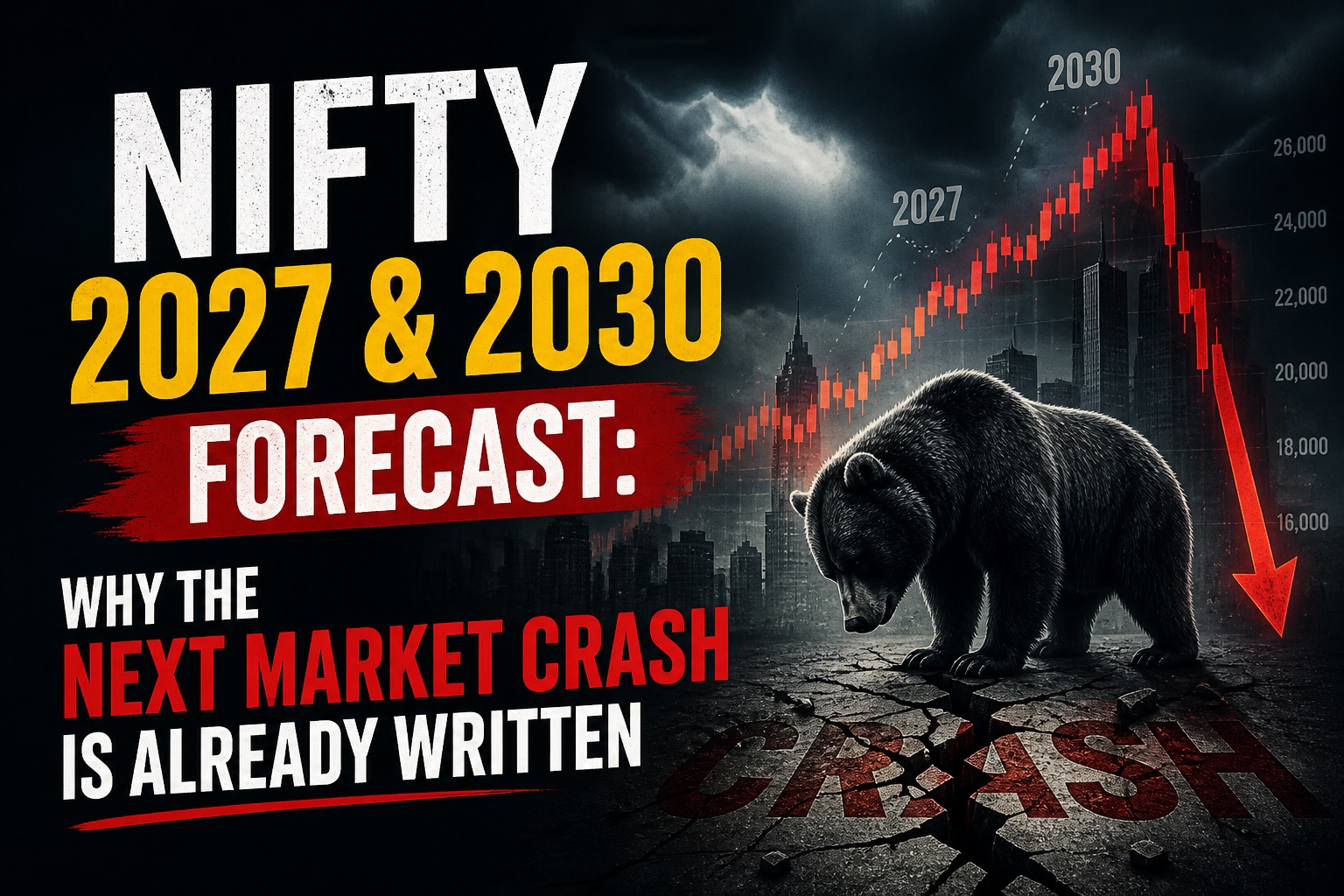
Here is what I think is coming over the next five years.
Crash
What I Expect
Nifty Drop
S&P 500 / Dow Drop
February – March 2027
Sharp correction
20% to 30%
20% to 30%
August 2029 – March 2030
Generational crash
30% to 45%
40% to 55%
The first one is a normal, painful correction. The second one is the kind of event that shows up once or twice in a lifetime. The rest of this article explains why I think this, and what I plan to do about it.
Why I Am Writing This Now
Right now, in May 2026, the mood in markets is calm and confident. Nifty has done well in 2024 and 2025. The S&P 500 and Dow are near all-time highs. SIP flows in India are at record numbers month after month. Volatility is low. Retail investors are happy.
This is exactly the kind of environment that makes me uneasy.
Markets do not crash when everyone is scared. Markets crash when everyone is comfortable. Gann said this in many different ways across his books. One line of his I keep coming back to is:
“There is nothing new under the sun.”
That line is actually older than Gann – it comes from Ecclesiastes in the Bible. But Gann used it as the foundation of everything he taught. The idea is simple. What has happened before will happen again, in roughly the same way, on roughly the same time intervals. Tops, bottoms, panics, rallies – they repeat.
And he said this too:
“The future is but a repetition of the past.”
If you accept that idea, the next question is just when. That is the question I have spent years trying to answer in my own way.
How I Look At The Market
I am a market data analyst by background. I have worked with spreadsheets for over twenty years, and on most days I spend eight hours or more inside Excel. Data is how I think. I love sitting with a clean dataset and finding the pattern that no one else has noticed yet.
A few years ago I started studying W. D. Gann seriously. The more I read, the more I realised that everything he taught came down to three things working together:
Time – when is the market likely to turn?
Price – at what level is it likely to turn?
Volume – is the move real, or is it a fakeout?
So I built my own system around these three. It runs on top of live market data, projects forward dates from major highs and lows, and looks for moments when time, price, and volume all line up. When they do, I pay close attention. When they do not, I stay out of the way.
I am not going to publish the exact maths behind it. That part stays private. But the conclusions in this article all come from that system, and from years of reading Gann’s books and the broader cycle literature alongside it.
If you want to learn the foundations of this kind of thinking, I teach it step by step in my W. D. Gann Trading Course. The course is the same material I started with myself, organised so you can move through it without getting lost.
CrashOne: The 2027 Correction
The first window I am watching is February to March 2027.
I expect a sharp drop here, somewhere between 20% and 30% on Nifty, with similar moves on the S&P 500 and Dow. This is not the end of the world. It is the kind of correction that resets things – leverage gets flushed out, retail traders get scared, valuations come down, and a new buying opportunity opens up.
So why this window?
A few different long-cycle anchors all line up here. The seventh year from the COVID bottom of March 2020 lands here. The eighteenth year from the 2009 GFC bottom passes through. The twenty-seventh year from the 2000 dot-com top arrives. And the fortieth year from the 1987 Black Monday panic completes.
One of these on its own is not a big deal. But four major anchors landing inside the same three-month window is uncommon. When I look back at every major Nifty and global market top of the last fifty years, that kind of cluster shows up before almost all of them.
Gann talked about the seven-year cycle as one of the most reliable timing tools he knew. The history backs him up. Look at the major down-moves:
1973 – 1974,
1980 – 1982,
1987,
2000 – 2002,
2007 – 2009,
2020
The gaps are not perfectly seven years, but they are close enough that you cannot ignore the pattern.
What I Will Be Watching In The Months Before
I do not just want to know when. I also want to see the warning signs in real time. Here is what I will be looking for between now and February 2027:
Nifty starts moving up almost vertically. Slope acceleration is the classic top signal.
Fewer and fewer stocks make new highs even while the index keeps rising. This is called narrowing breadth, and it shows the rally is getting tired.
Margin debt explodes higher in the U.S. F&O turnover surges in India.
Crypto and IPO mania returns. Everyone has a hot tip.
India VIX stays below 10 for weeks. U.S. VIX stays below 12. Volatility is too quiet.
If three or four of these show up at the same time in late 2026, I will get more confident in the February 2027 view.
The Bottom Is A Buying Zone
I think the low of this correction lands in the last ten days of March 2027. That is the part most investors get wrong. They sell at the bottom because the news is bad and everyone is scared.
The right move is the opposite. The seven-year cycle low has historically been one of the best places to buy quality stocks for the next leg up. March 2009 and March 2020 are the two most recent examples. Both felt terrible at the time. Both ended up being some of the best buying moments of a generation.
If you are running SIPs through this window, just keep going. The math will work in your favour. If you are an active investor, what I would do – and what I plan to do – is build a cash buffer of around 25% to 35% through the second half of 2026. Not because I am bearish today, but because I want to have firepower when the cycle bottoms in March 2027.
CrashTwo: The 2029-2030 Reset
This is the part of the article I want you to read carefully.
Sometime between August 2029 and March 2030, my cycle work points to a much bigger market event. The cluster of cycle anchors landing in this window is the densest I have seen in any modern period.
I want to be clear about what I am not saying. I am not predicting a war. I am not predicting hyperinflation or the end of capitalism. I am not making any specific call about what will trigger the move.
What I am saying is that the time architecture of this period looks like 1929. It looks like 1973. It looks like 2000. It looks like 2008. The trigger, when it shows up, will look obvious in hindsight. While it is happening, it will feel like the world is ending.
Why This Window Stands Out
The single biggest reason is that 2029 marks one hundred years from the 1929 Wall Street Crash. Gann placed huge weight on the hundred-year cycle. He believed it was the master rhythm of economies and civilisations. He was not the only one – Russian economist Kondratieff and many others have studied long cycles and reached similar conclusions from different starting points.
On top of the centennial, several other anchors arrive in the same window:
Twenty years from the 2009 GFC bottom.
Thirty years from the 2000 dot-com peak.
Ten years from the 2020 COVID bottom.
Forty-two years from 1987 Black Monday.
One or two of these would be normal. Five of them clustering together inside six months is rare. The last time this kind of density showed up in cycle history was the 1929 to 1932 period itself.
How Big And How Fast
For Nifty, I think the drop will be in the 30% to 45% range. India has structural strengths – demographics, formalisation of the economy, manufacturing capex, household savings moving into equities – that will probably cushion it relative to the U.S. But Nifty will not escape. It will move down with the world.
For the S&P 500 and Dow, I think the drop will be deeper, in the 40% to 55% range.
The probable top arrives in early September 2029, which is almost exactly the same month as the September 1929 high. The probable bottom arrives in March 2030. The symmetry with 1929-1932 is striking. I do not think it is a coincidence.
What This Means For Your Portfolio
This is important. I am not telling you to sell today. There are probably three to four good years left before this window opens, and selling in May 2026 because of a 2029-2030 forecast would be a serious mistake. Bull markets make their final tops in euphoria, not in caution.
What I am telling you is that starting around late 2028, every long-term portfolio should go through a serious risk audit. Some questions worth asking yourself:
How much of my net worth do I really need to compound through the next decade, versus protect through the next big drop?
Do I have twelve months of expenses in cash, or three?
Am I diversified across countries, asset classes, and styles? Or am I concentrated in one type of investment?
If I lose 40% on my portfolio, can I sleep at night and not panic-sell at the bottom?
A bull market never asks these questions. You have to ask them yourself, well before the moment of truth arrives.
What I Watch In Nifty Specifically
The Indian market has its own personality. It does not move exactly like the U.S. It tends to be more resilient on the way down and stronger on the way up. But it does move in the same direction, and the same cycles apply.
For Nifty, the structural picture stays positive into 2027 and 2028. None of that contradicts what I have written above. Bull markets always look strongest right before the top. The question is which sectors will start cracking first when the cycle turns.
The four sectors I will watch closely as early-warning signals:
Banks and NBFCs. Historically, financials are the first thing to crack at major tops. Often six to nine weeks before the broader index makes its high.
Smallcap and microcap indices. These are the breadth canary. They top out before the largecaps do.
Real estate and infrastructure. Late-cycle leadership tends to flame out hard.
How fast leadership rotates. When sector leadership is changing every two weeks, the cycle is close to running out of fuel.
I will not publish specific Nifty levels right now. We are too far from the event. As 2026 ends and 2027 begins, I will publish targeted updates if my system confirms the path.
One More Thing About Method
Some readers will want to know exactly how I get to these dates. I am keeping that part private – it is the result of a lot of work, and it is the engine behind everything I do.
What I will say is this. None of it is magic. It is just careful study of price, time, and volume across many decades of market data, organised through the framework Gann left behind. He spent forty-five years figuring this out. I am still learning, and I will keep learning for as long as I am alive.
I do not believe markets are perfectly predictable. Free will, government policy, and surprise events can change outcomes. What I do believe is that the probability fields shaped by long cycles are real. Pay attention to them, and you have an edge over investors who ignore them.
One last Gann quote I keep close:
“News and events do not move the market. The market moves to news and events because the time has arrived for the move.”
COVID did not crash the market in 2020. The market was already at a multi-cycle top, and COVID was the news that filled the empty space. The same will be true for whatever triggers the 2027 correction and the 2029-2030 reset. The cycle will be visible long before the trigger appears.
Closing Thoughts
I am writing this in May 2026 with markets calm and most investors confident. By the time you read this in some future month, things may already look different.
If I am wrong about 2027, I will say so. If I am wrong about 2029-2030, I will say so. A forecaster who cannot accept being wrong has no business publishing forecasts.
But if even one reader uses this article as a reason to review their position sizing, build a stronger emergency fund, or just sit with the uncomfortable thought that the next five years may not look like the last five, then this writing has done its job.
Markets reward humility. They punish certainty. The student who keeps studying long after the lesson seems learned is the one who survives every cycle.
I will be watching. I hope you will watch with me.
FAQs
When is the next stock market crash expected?
My cycle research points to two windows. The first is a sharp correction between February and March 2027. The second, much larger, is a generational crash between August 2029 and March 2030.
How big could the 2030 crash be on Nifty?
I expect a Nifty drop of around 30% to 45% peak to trough in the 2029-2030 window. Global indices like the S&P 500 and Dow may fall harder, in the 40% to 55% range.
What method are you using for this forecast?
I use a custom system built around W. D. Gann’s framework of time, price, and volume. The exact maths is private, but the foundations are taught in my W. D. Gann Trading Course.
Should I sell my stocks now based on this forecast?
No. There are probably three to four good years left before the 2029-2030 window opens. Selling now would be a costly mistake. This article is for planning ahead, not for panicking today.
Can I learn this method myself?
Yes. The foundations are not hidden. Gann wrote about them in books like The Tunnel Thru the Air and 45 Years in Wall Street. My online course walks you through them in the right order, with examples that make them practical.
About The Author
Ajit Yadav is a student of W. D. Gann and a market data analyst with more than twenty years of professional experience. He spends most of his working day inside Excel, building and testing the cycle and confluence systems that drive his research. He writes long-form market analysis at KooCapital.com and teaches the W. D. Gann Trading Course Online.
Disclaimer
This article is my personal research and study. It is shared for educational purposes only. It is not investment advice. It is not a recommendation to buy or sell anything. I am not a SEBI-registered investment advisor. Markets carry real risk. Past patterns do not guarantee future outcomes. Please speak to a qualified financial advisor before making any investment decision. The views here are my own. KooCapital.com and the author take no responsibility for any losses anyone may have from acting on this article.
If this kind of writing is useful to you – subscribe to KooCapital for monthly cycle updates, or take the W. D. Gann Trading Course to learn the foundations behind it.